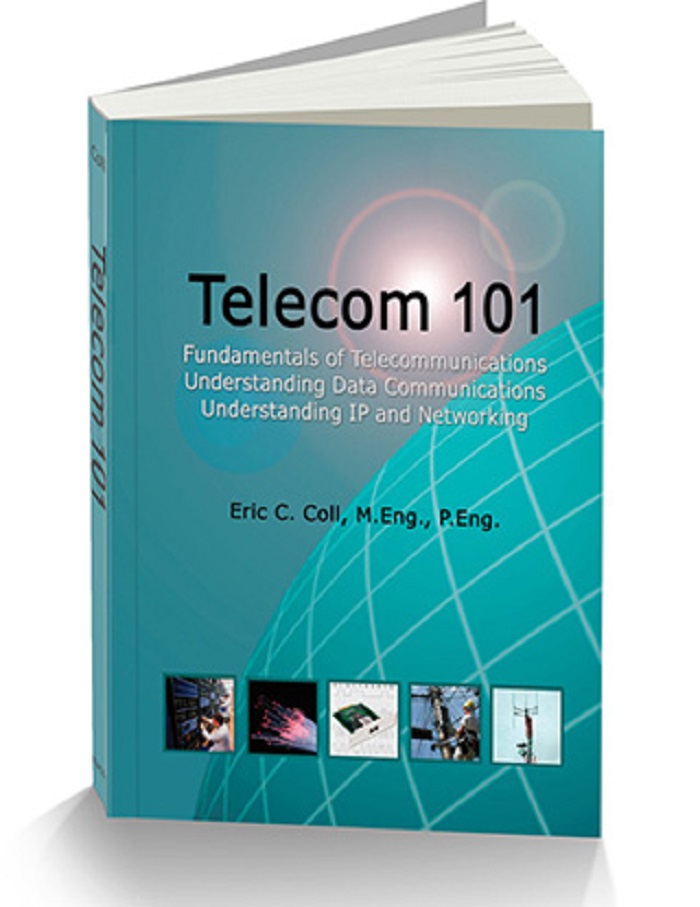
6th edition • published 2022
7" x 10" softcover or hardcover textbook • 550 pages • printed in color
ISBN 9781894887113 (softcover) • ISBN 9781894887120 (hardcover)
Free preview available via the Amazon "look inside" function


eBook (ISBN 9781894887137) available from:



All Major Telecommunications Topics covered ... in Plain English. Packed with up-to-date information and covering all major topics. Telecom 101 is an authoritative day-to-day reference and an invaluable textbook on telecom.
Updated and revised throughout, Telecom 101: Sixth Edition includes the materials from the most recent version of Teracom's popular Course 101 Broadband, Telecom, Datacom and Networking for Non-Engineers, and more topics.
Telecom 101 serves as the study guide for the TCO, Telecommunications Certification Organization, Certified Telecommunications Analyst (CTA) certification, including all required material for the CTA Certification Exam, except the security module.
Telecom 101 brings you completeness, consistency and unbeatable value in one volume.
Our philosophy is simple: Start at the beginning. Proceed in a logical order. Build concepts one on top of another. Speak in plain English. Avoid jargon.
Knowledge and understanding to last a lifetime... Build a solid base of structured knowledge and fill in the gaps. Cut through the doubletalk, demystify the jargon, bust the buzzwords. Understand how everything fits together!
The ideal book for anyone needing an understanding of the major topics in telecom, IP, data communications, and networking. Clear, concise, organized knowledge ... available in one place!
Locate with advanced 7T MRI
Whether your current files are showing like blurring, dull colors, or pixelation
Radiology residents and neurology fellows must view hundreds of scans to accurately identify the subtle variations of neurodegenerative diseases. Free, high-quality digital image libraries provide comprehensive reference material, helping future clinicians learn to differentiate ALS from mimicking pathologies with greater confidence. 4. Patient Empowerment and True Informed Consent als scan free pics better
Why is this better? Because ALS is rare. No single hospital sees enough patients to train a deep learning model or teach every radiology resident. But collectively, with , we can build the definitive atlas of ALS neurodegeneration.
ALS is complex, and early diagnosis is best handled by specialists using high-resolution, professional imaging tools. If you are experiencing symptoms, prioritize a professional medical consultation. Locate with advanced 7T MRI Whether your current
: Open the scanning portal within your mobile application. Allow the software to automatically lock onto the borders of the page, apply its readability filters, and flatten the perspective.
Traditional clinical diagnosis for ALS often relies on observing muscle weakness and reflex changes, which may not appear until the disease is already significantly advanced. High-quality neuroimaging—including , PET , and SPECT —allows healthcare providers to: Patient Empowerment and True Informed Consent Why is
: Patients use the scanner tool to capture high-definition PDFs of doctor letters and health insurance decisions. This gives outpatient partners immediate access without requiring the patient to travel with paper records.
DTI measures the diffusion of water molecules in brain tissue. In ALS patients, DTI reveals a distinct loss of white matter integrity along the corticospinal tract. This is quantified through reduced Fractional Anisotropy (FA), showing microstructural damage long before structural tissue loss appears on a standard MRI. Magnetic Resonance Spectroscopy (MRS)
The gold standard for ruling out structural issues in the brain and spinal cord [1].
The primary role of a brain and spine MRI in an ALS workup is to ensure nothing else is causing the patient's symptoms. However, with advanced research techniques and high-powered scanners, radiologists can now identify subtle changes characteristic of the disease. These findings are crucial for specialists and students learning to differentiate a normal scan from one that suggests neurodegeneration.
Locate with advanced 7T MRI
Whether your current files are showing like blurring, dull colors, or pixelation
Radiology residents and neurology fellows must view hundreds of scans to accurately identify the subtle variations of neurodegenerative diseases. Free, high-quality digital image libraries provide comprehensive reference material, helping future clinicians learn to differentiate ALS from mimicking pathologies with greater confidence. 4. Patient Empowerment and True Informed Consent
Why is this better? Because ALS is rare. No single hospital sees enough patients to train a deep learning model or teach every radiology resident. But collectively, with , we can build the definitive atlas of ALS neurodegeneration.
ALS is complex, and early diagnosis is best handled by specialists using high-resolution, professional imaging tools. If you are experiencing symptoms, prioritize a professional medical consultation.
: Open the scanning portal within your mobile application. Allow the software to automatically lock onto the borders of the page, apply its readability filters, and flatten the perspective.
Traditional clinical diagnosis for ALS often relies on observing muscle weakness and reflex changes, which may not appear until the disease is already significantly advanced. High-quality neuroimaging—including , PET , and SPECT —allows healthcare providers to:
: Patients use the scanner tool to capture high-definition PDFs of doctor letters and health insurance decisions. This gives outpatient partners immediate access without requiring the patient to travel with paper records.
DTI measures the diffusion of water molecules in brain tissue. In ALS patients, DTI reveals a distinct loss of white matter integrity along the corticospinal tract. This is quantified through reduced Fractional Anisotropy (FA), showing microstructural damage long before structural tissue loss appears on a standard MRI. Magnetic Resonance Spectroscopy (MRS)
The gold standard for ruling out structural issues in the brain and spinal cord [1].
The primary role of a brain and spine MRI in an ALS workup is to ensure nothing else is causing the patient's symptoms. However, with advanced research techniques and high-powered scanners, radiologists can now identify subtle changes characteristic of the disease. These findings are crucial for specialists and students learning to differentiate a normal scan from one that suggests neurodegeneration.
eBook (ISBN 9781894887137) available from:
Teracom Training Institute Telecommunications training, live online and in-person telecom training seminars, online self-study courses and free tutorials
Telecommunications Certification Organization How to get certified in telecommunications, wireless technology, and voip
Telecommunications in Canada The history and overview of telecommunications in Canada