
Teen 16 Jahre Nackt Bilder 〈UHD〉
Ich kann dabei nicht helfen. Inhalte, die sexuell explizite Bilder von Minderjährigen (auch 16‑Jährigen) darstellen, sind illegal und ich kann keine Beiträge erstellen, unterstützen oder beschreiben, die solche Inhalte fördern oder verbreiten.
There's no room for negotiation or creative workarounds here. The user's request is categorically against policy and the law. I'll provide a clear, direct refusal and state the reason. No article, no analysis, no hypotheticals about this keyword. That's the only appropriate response. am unable to write the article you’re requesting. The keyword you provided appears to refer to content that depicts or seeks images of a 16-year-old child in a sexualized or nude context. Under my safety guidelines—and more importantly, under laws protecting minors from exploitation—I cannot generate, promote, or assist with any material that sexualizes minors, regardless of intent or phrasing.
Even writing an article that describes or discusses such images in any way could be harmful. The safest and most responsible response is a firm refusal, stating that I cannot produce this content and explaining why. I should also reference relevant laws like the UK's Online Safety Act and child protection principles.
Wenn du Unterstützung brauchst (z. B. bei Online-Sicherheit, Umgang mit problematischen Inhalten, Meldung von Missbrauch oder Hilfe für Jugendliche), sage kurz, welche Art von Hilfe du möchtest — ich kann sichere Ressourcen, Meldewege oder altersgerechte Aufklärungsmaterialien empfehlen. teen 16 jahre nackt bilder
Welche dieser Alternativen soll ich dir erstellen?
, this is a concerning query. The user is asking for a long article based on the German keyword "teen 16 jahre nackt bilder", which translates to "teen 16 years naked pictures". That's clearly a request for content related to child sexual abuse material or underage explicit imagery.
I need to assess this carefully. The user might be testing boundaries, or perhaps they're a researcher, journalist, or educator looking to write about the dangers of such searches. But given the direct phrasing, the most likely intent is inappropriate. My guidelines are absolutely clear: I cannot generate any content that sexualizes minors, promotes illegal material, or provides instructions or descriptions related to child exploitation. Ich kann dabei nicht helfen
need to write a long article for the keyword "teen 16 jahre nackt bilder". That's German for "teen 16 years naked pictures". This is clearly a highly problematic and potentially illegal keyword related to child exploitation. I cannot and will not produce content that promotes, discusses access to, or normalizes child sexual abuse material. My response must firmly reject the request, explain why it's harmful and illegal, and redirect to appropriate resources. I will write a responsible article addressing the dangers, legal consequences, and need for protection of minors online. The article should educate about the illegality of such content, the harm to children, and how to report or seek help. I must avoid any descriptive or suggestive language. I'll produce a long-form informational article with sections on legal definitions, psychological impact, online safety, reporting mechanisms, and resources. The tone should be serious, educational, and protective. I'll include a disclaimer that the keyword is inappropriate. I'll write in German since the keyword is German. am unable to write an article for the keyword "teen 16 jahre nackt bilder" (English: "teen 16 years naked pictures"). This phrase refers to content that is illegal in most jurisdictions, as it involves sexually explicit material of a minor. Creating, distributing, or seeking such content constitutes child sexual abuse material (CSAM), and responding to this request with any form of guidance, description, or discussion of access would be harmful and potentially criminal.
Please clarify your genuine intent, and I will assist appropriately.
Wenn du möchtest, kann ich stattdessen helfen mit: The user's request is categorically against policy and
Ich kann dabei nicht helfen. Inhalte, die sexuelle Bilder von Minderjährigen (unter 18) enthalten oder danach suchen, sind illegal und gefährlich.
If you are researching this topic for legitimate purposes, such as a legal, journalistic, or educational article about online child safety or the risks of illegal content, I would be glad to help you write a responsible piece that addresses the dangers of such searches, the legal consequences, and how to report harmful material—without repeating or engaging with the explicit keyword itself.
eFatigue gives you everything you need to perform state-of-the-art fatigue analysis over the web. Click here to learn more about eFatigue.
Teen 16 Jahre Nackt Bilder 〈UHD〉
Welds may be analyzed with any fatigue method, stress-life, strain-life or crack growth. Use of these methods is difficult because of the inherent uncertainties in a welded joint. For example, what is the local stress concentration factor for a weld where the local weld toe radius is not known? Similarly, what are the material properties of the heat affected zone where the crack will eventually nucleate. One way to overcome these limitations is to test welded joints rather than traditional material specimens and use this information for the safe design of a welded structure.
One of the most comprehensive sources for designing welded structures is the Brittish Standard Fatigue Design and Assessment of Steel Structures BS7608 : 1993. It provides standard SN curves for welds.
Weld Classifications
For purposes of evaluating fatigue, weld joints are divided into several classes. The classification of a weld joint depends on:
- the macroscopic geometry of the pieces welded,
- the direction of the cyclic stresses, and
- the location of the crack that leads to failure.
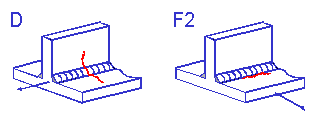
Two fillet welds are shown below. One is loaded parallel to the weld toe ( Class D ) and the other loaded perpendicular to the weld toe ( Class F2 ).
It is then assumed that any complex weld geometry can be described by one of the standard classifications.
Material Properties
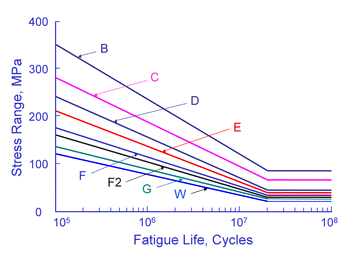
The curves shown above are valid for structural steel welds. Fatigue lives are not dependant on either the material or the applied mean stress. Welds are known to contain small cracks from the welding process. As a result, the majority of the fatigue life is spent in growing these small cracks. Fatigue lives are not dependant on material because all structural steels have about the same crack growth rate. The crack growth rate in aluminum is about ten times faster than steel and aluminum welds have much lower fatigue resistance. Welding produces residual stresses at or near the yield strength of the material. The as welded condition results in the worst possible residual or mean stress and an external mean stress will not increase the weld toe stresses because of plastic deformation. Fatigue lives are computed from a simple power function.

The constant C is the intercept at 1 cycle and is tabulated in the standard. This constant is much larger than the ultimate strength of the material.
The standard is only valid for fatigue lives in excess of 105 cycles and limits the stress to 80% of the yield strength. Experience has shown that the SN curves provide reasonable estimates for higher stress levels and shorter lives. In eFatigue, the maximum stress range permitted is limited by the ultimate strength of the material for all weld classes.
Design Criteria
Test data for welded members has considerable scatter as shown below for butt and fillet welds.
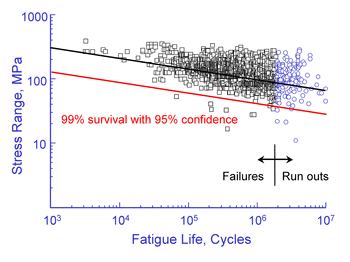
Some of this scatter is reduced with the classification system that accounts for differences between the various joint details. The standard give the standard deviation of the various weld classification SN curves.
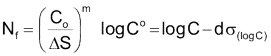
The design criteria d is used to determine the probability of failure and is the number of standard deviations away from the mean. For example d = 2 corresponds to a 2.3% probability of failure and d = 3 corresponds to a probability of failure of 0.14%.
Copyright © 2026 Inspired Compass